A Prayer for Peanuts & Professors
by Tessa Squissato
Published in Pseudo Magazine Issue 1
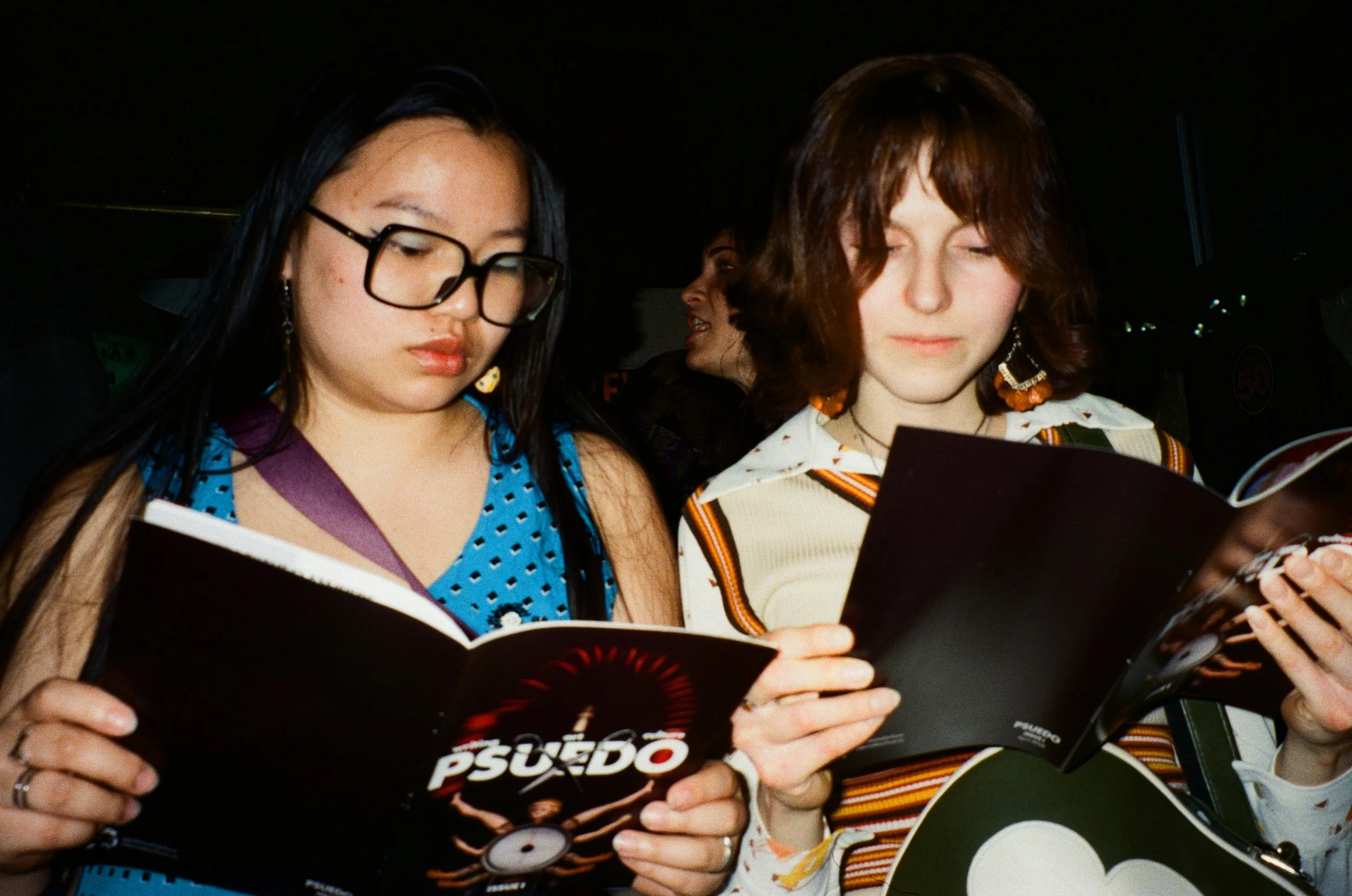
Alicia & Tessa at the Pseudo Launch Party (Photo by Riley Vilis)
As the daughter of a recovering Catholic, I’ve often felt as if I inherited all of the guilt and none of the faith.
I discovered a miniature picture of Jesus in my mom’s jewelry box when I was about five. He and his herd of sheep were enshrined in an ornate gold frame, and I adored this little treasure. I doubt this was for any biblically significant reason, the appeal was most likely its small size and depiction of fluffy animals. Whatever the case, my obsession ran deep.
“Who do you love?” my mom would ask.
“Jesus!” I would reply.
Later on when my ‘love’ for Jesus was stuffed back in the jewelry box, strangled by a stray silver chain, and buried in earrings, I became a staunch atheist. My mom would occasionally recount the Sunday School tales of her childhood, but only as stories to amuse, not lessons to be taught. And amuse me they did.
“Then Jesus walked on water,” my mom would say.
“That’s ridiculous!” I would reply.
I certainly got a little more woo woo as I grew older and the people I loved started dropping like flies, but organized religion remained enemy #1. I firmly believed that the majority of the world’s evils were religiously fuelled, and therefore, religion itself was the greatest evil of them all. Only late last year did I begin to rethink my godless ways.
Over the summer, I picked up a book called A Prayer for Owen Meany by John Irving. While chock-full of Christianity, the novel carries a message of universal spiritualism bundled in a tiny package— a translucently-pale, shrill-voiced boy named Owen Meany. His is a story of divine purpose, a meticulous, and beautifully told ‘everything happens for a reason’ tale. Though this kind of fate-centric belief is usually associated with Christianity, it has always held some spiritual resonance for me. Still,I was taken aback by the glimpses I saw of my own beliefs in those of Owen ‘God’s Instrument’ Meany. Could I really find commonality with a devout Christian? I suppose I could, and thus, a fictional character forced me to reconsider my view of the living, breathing religious individual.
Though I was not yet ready to accept Jesus (back?) into my heart, I gained a little more acceptance for those who had. I began to realize that it was perhaps unfair to ridicule individuals who allowed hope into their lives simply because I often barred it from mine. This was an early come to Jesus moment— if you will— but the real one came a little while later.
On Halloween day, I conducted a life story interview with my professor, Dr. Gary Gould. Prior to this, I chatted with Gary frequently, but I don’t think I ever knew he was a Christian. All was soon revealed as the conversation morphed into an hour-long religious discussion, and a very welcome one at that.
“Just because you go to church, doesn't make you a Christian, like going to McDonald's doesn't make you a hamburger, right?” Gary asked.
“Yes,” I thought. “That’s absolutely right.”
I’ve never truly hated religion or its followers, I just cannot stand the way people pervert its tenets and commit unspeakable acts ‘in the name of God’! Unlike Gary who embodies the essence of ‘love thy neighbour’, these people may claim to worship at the foot of the Golden Arches, but they will never be Big Macs.
Now, I must bring it back to the Peanuts of it all. Though never religious, I have always been a Schulzian disciple. So when I discovered a book called A Charlie Brown Religion, it became my bible. Author Stephen J. Lind details Schulz’s life through the lens of his Christian faith, emphasizing his rather unique belief that God could “be worshiped only by the love that we show for other creatures”, and as such, God welcomes all who do “good things for others” irrespective of one’s religious devotion or lack of it.
Charles Schulz, another Big Mac.
Thanks to these individuals, my formerly heretical heart has become enlightened to the merits of religious practice. But now, more than ever, I question why people must take doctrines which can evidently be used as guiding tools for good, and warp them into weapons wielded in fights of celestial insignificance. While I have no answer to this, I am quite certain that the Little Man and His sheep would much prefer a world full of Garys and Schulzs.
