
Sweet Charity and Joan
by Alicia Unwin
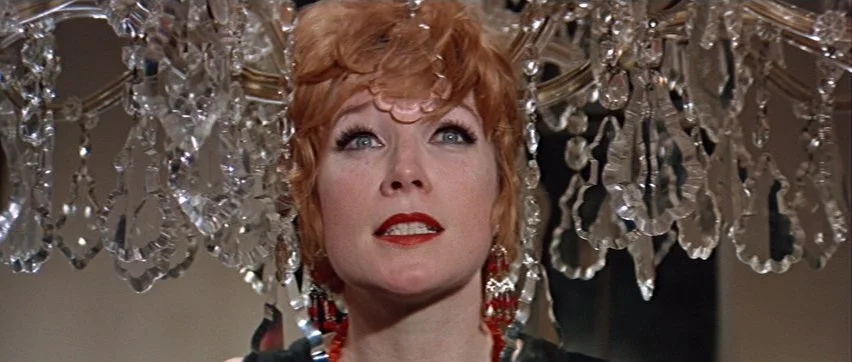
Image via IMDB
In remorseful moments, often times when I’ve had an argument with my father, and each
of us has stormed off to stew in our own corners of the house, my mother, ever the peacemaker
and go-between, reminds me of my father’s alcoholic mother. Joan, in her worst episodes, had a
sharp temper which could take a turn. In Bob Fosse’s Sweet Charity (1969), Shirley MacLaine
portrays a woman like Joan, layered, and complicated. In all honesty, I do not know much about
Joan or her life, nor did I ever meet her in my lifetime, but there are a few facts that I have
gathered through brief reminiscences and stories about her that got me thinking past her flaws.
Joan was a fiery red-head, who immigrated with my granddad from Sheffield, England with my
aunt and dad, who were just babies, into a wartime house in Dundas, Ontario. She worked at a
fish and chips shop on Main Street. When my dad was a kid she would toss dough balls in the
fish fryer, fry them into donuts and bring them home. I also know a common remark she made
following the mention of someone getting a shiver or chill up their spine was, “that means
someone walked over your grave.”
It seems like Joan was a thoughtful and tough woman, who suffered from a hardship that I can
not speak much about for lack of experiencing it first hand, but it made my father uncomfortable
enough to be very deterred from watching the film in its entirety.
The film follows Charity, played by red-headed Shirley MacLaine, a taxi cab dancer who seems
to be down on her luck in all regards, from making it big in the world financially, socially and
when it comes to the men she dates. In the opening scene at Central Park, Charity thinks she’s
found the one, only to be dumped–quite literally–over a bridge and into the scummy pond, while
the guy steals away with her hard-earned money. Throughout the movie’s plot Charity becomes
torn between two men who have fallen for her. There’s the kind, yet fearful and anxious Oscar,
and the wealthy, but self-centred Vittorio. Lying to Oscar about living a dignified life as a bank
worker, and fooling around with Vittorio despite being the other woman in the relationship,
Charity is sucked into a whirlwind of lies, justifying it every step of the way because she’s
determined to make it big.
For my father seeing the trials and tribulations of Charity’s misfortune and lies, one after another,
was a little overwhelming. It was a reminder to him of a blue-eyed red-headed woman who came
from a poor background, who had rotten out of luck experiences in life. As I watched this film in
parts over the course of a week I remember my dad stepping into the room every now and then to
see what other trouble Charity had gotten herself into. Shaking his head, he would swiftly leave
the room saying, “Agh, I can’t watch this!” Despite his reluctance to see the whole plot pan out,
once I had finished the film he did check back to see if Charity did in fact find some redemption
in the end. Unfortunately, the DVD cut I watched ended with her broken hearted, manless, with
only hippies to cheer her up. However, later on as I was flipping through the special features I
was ecstatic to discover an alternative ending, which was much happier for Charity and for us,
the viewers!
It is with the same positive alternative-note in which the film ended that I can say, even though
there are some notable hardships from Joan's life, whenever my sister and I ask about her, my
parents always say “she would’ve loved you girls”. These words and the brighter stories of her
life are what stick with me as pseudo-memories of who she was.
